
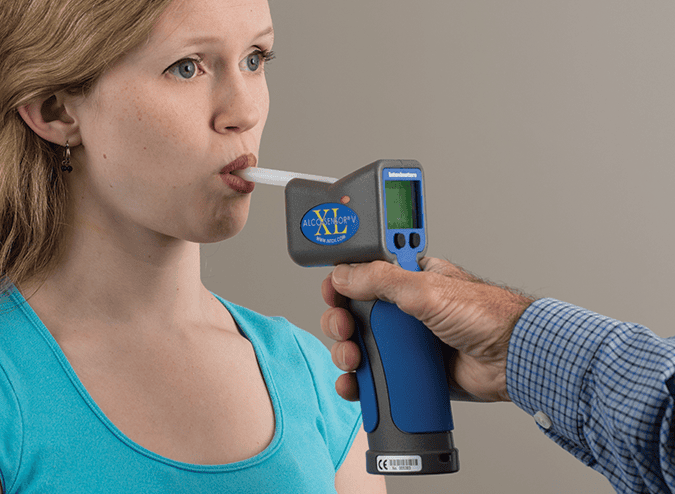
A DOT alcohol test follows two possible paths. A screening result below 0.020 ends the alcohol testing process. A screening result of 0.020 or higher requires a separate confirmation test conducted by a qualified Breath Alcohol Technician (BAT) on an approved evidential breath testing device (EBT). The confirmed result determines what the employer must do.
These procedures come from 49 CFR Part 40, the common testing rule for federally regulated transportation workplaces. The applicable DOT agency rule determines which employees are covered, when tests are required, and how long an employee with a confirmed result between 0.020 and 0.039 must stay out of safety-sensitive work. This guide explains the procedure and the two-site handoff.
Screening versus confirmation: what changes?
The first test, a screening test, determines whether an employee may have an alcohol concentration at or above the threshold. A qualified Screening Test Technician (STT) or BAT can conduct screening with a permitted device. DOT-approved alcohol screening devices (ASDs), including qualifying saliva or breath devices, and approved EBTs can be used for screening tests. An ASD cannot be used for confirmation. Confirmation is the second and final test performed by a qualified BAT on an approved EBT.
A DOT alcohol screening test result of 0.020 or greater is considered positive and triggers the confirmation test sequence, which starts with a controlled waiting period followed by the test using an confirmation-capable EBT. Read our article, “Breath and Saliva Alcohol Testing in Workplace Programs” for advantages and limitations of each test type.
| Test | Device & Technician | Result Actions |
| Screening | Approved ASD or EBT; qualified STT or BAT | Below 0.020 – negative test, document and report 0.020 and greater – proceed to confirmation test procedures |
| Confirmation | Approved EBT; qualified BAT | The confirmed concentration (BrAC), controls the employer’s required response |
Prepare the site, people and equipment
The testing site must restrict unauthorized access and protect the process. A BAT or STT tests one employee at a time and testing should begin without undue delay. If a DOT drug test is also required, the alcohol test should be completed first to the greatest extent practicable.
The testing technician obtains positive employee identification, explains the test procedure, and shows the employee the instructions on the back of the DOT Alcohol Testing Form (ATF). The technician completes Step 1, reads the statement in Step 2, and directs the employee to sign and date Step 2 of the form. If the employee refuses to sign Step 2, the technician records the refusal in Remarks and immediately notifies the designated employer representative (DER). Under Part 40, refusing to sign Step 2 and submit to the test is a refusal to test.
Technicians must use only devices authorized for the particular test and they’ve received training on. A confirmation EBT must, among other capabilities, assign a unique test number, print the test result, perform an air blank and external calibration check, and distinguish alcohol from acetone at the 0.020 level. Users follow the manufacturer’s quality assurance plan (QAP), including external calibration check intervals. An EBT that fails a check goes out of service until repaired and passes a check. For an ASD, follow its QAP, expiration dates and applicable Part 40 directions.
Conduct the screening test
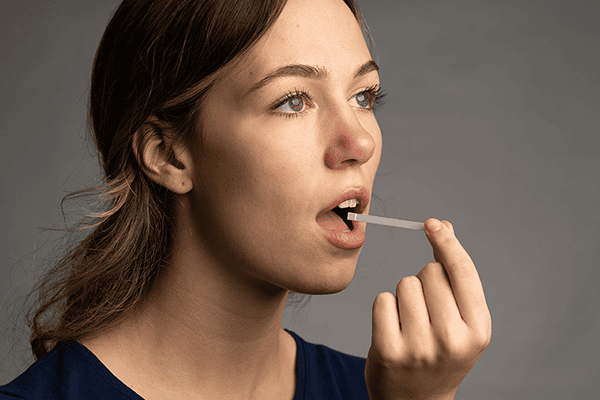
For breath screening using an EBT or ASD, the technician opens an individually wrapped mouthpiece in the employee’s view and instructs the employee to blow long and steady until the device indicates an adequate breath sample was provided. The technician shows the employee the result as it appears on the display. A device printout containing the required test and instrument details is either directly printed on the ATF, or affixed to the designated ATF space with tamper-evident tape or a tamper-evident self-adhesive label. If the device does not produce the required printout, the technician may record the specified details in Step 3 by hand.
Saliva ASDs have different collection and reading instructions. For example, a saliva ASD must be within its expiration date and results read according to the manufacturer’s timing, always within 15 minutes of the test. That reading deadline is distinct from the minimum 15-minute wait before confirmation. The technician records the ASD type, lot and expiration date, and result in Step 3 as required.
For a screening result below 0.020, the BAT or STT signs and dates Step 3 and transmits the result to the DER. At 0.020 or higher, the technician directs the employee to confirmation testing. An invalid screening test is documented as cancelled and repeated when practicable under Part 40’s correction procedures.
The minimum 15-minute wait before confirmation
The waiting period begins when the screening test is completed and lasts 15 minutes. Afterward, the BAT should begin confirmation testing as soon as possible, and preferably no more than 30 minutes after screening completion. A BAT, STT or employer representative may observe the employee during the wait period.
Upon completion of the screening test, the technician starts a 15-minute timer and gives the employee the confirmation instructions. The employee is instructed not to eat, drink, put anything such as gum or a cigarette into the mouth, or belch. The technician explains that residual mouth alcohol can produce an artificially high reading, that following the instructions benefits the employee, and that the test will proceed at the end of the wait period even if the instructions are not followed. A known failure to follow instructions are noted in the ATF Remarks line. The technician does not automatically cancel the test because the employee belched or chewed gum.
A confirmation performed before the full 15 minutes is a fatal flaw, cancelling the test. If confirmation testing cannot begin within 30 minutes, the BAT still proceeds with confirmation rather than repeating screening and documents the elapsed time and reason for delay.
When screening and confirmation occur at different sites
A two-site test follows a specific path, requiring a documented, observed handoff. If a second BAT will perform confirmation, the screening BAT or STT follows these steps after a result of 0.020 or higher:
- Complete the screening record. Give confirmation test and wait-period instructions to the employee, Make a note in the remarks section, “The 15-minute wait instructions were given”, and the time the instructions were given so the waiting period can be measured by the second BAT. Sign and date Step 3 of the screening ATF and give the employee Copy 2.
- Confirm the employee’s transfer and instruct the person accompanying the employee to the second location to carry a copy of the screening ATF to the confirmation BAT. Ensure that the employee is observed during transport by a BAT, STT or employer representative. Direct the employee not to drive a motor vehicle to the second site.
Travel time to the second location counts toward the 15-minute waiting period if the screening technician gave the wait instructions. At the confirmation test site, the second BAT reviews the screening ATF. If the BAT cannot verify from that form that the wait instructions were given, the BAT must give the wait instructions to the employee and carry out the full waiting-period requirement rather than assume that travel fulfilled it. Observation must continue during any remaining wait.
If the BAT can verify from the form the wait instructions were given and the wait period was fully carried out, the BAT will start the confirmation test without delay. Because the second BAT did not perform the screening test, that BAT verifies the employee’s identification, explains the confirmation test procedure, and uses a new ATF. The second BAT completes Step 1, directs the employee to sign and date Step 2, and notes in Remarks that a different BAT or STT performed the screening test. The BAT records the elapsed time between screening and confirmation and, if confirmation could not begin within 30 minutes, why. Under no circumstances is the BAT start a second screening test.
Air blank and EBT confirmation
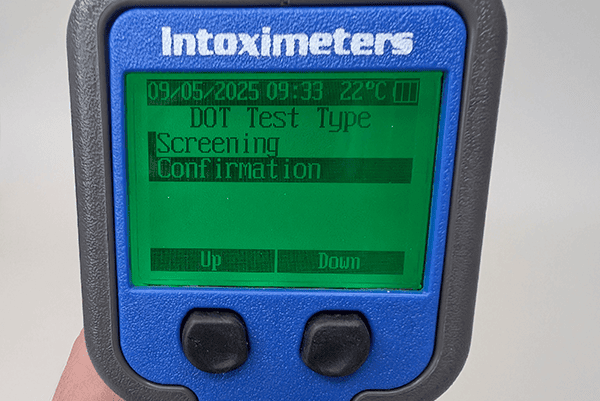
Before the employee’s confirmation breath sample, an air blank on the EBT must be performed in the employee’s presence. Most EBTs automatically initiate the air blank at the start of the confirmation test. If the air blank result shows a 0.00 reading the test proceeds. If the air blank is above 0.00, the BAT is allowed to conduct a second air blank. If the result of the air blank is above 0.00, the EBT must be taken out of service. The BAT may administer the test using another EBT if available. The removed instrument cannot return to DOT testing until an external calibration check finds it within tolerance.
Skipping the confirmation air blank, proceeding without a 0.00 air blank, or lacking a printed confirmation result is a fatal flaw.
After a valid air blank, the BAT Follows similar test protocols mentioned in the screening test to obtain a breath sample. The BAT shows the employee the displayed result, then the printed result and test number. A confirmation test printout is attached in the second block with tamper-evident tape or a tamper-evident self-adhesive label. Confirmation test results should never be handwritten in Step 3.
Confirmation Test Result Concentrations and Actions
A confirmed 0.020–0.039 result is not the 0.040 DOT alcohol violation threshold, but it still requires prompt action. For FMCSA-covered drivers, 49 CFR § 382.505 bars safety-sensitive functions until the start of the next regularly scheduled duty period, but for no less than 24 hours after a result of at least 0.020 but less than 0.040. Other DOT agency rules may prescribe different periods. Read our article, “DOT Breath Alcohol Testing Violations and Prohibited Conduct” to learn about actions employers must take.
| Confirmation BrAC Result | DOT Action |
| Below 0.020 | BAT completes and reports the result; no further action required or permitted |
| 0.020 to 0.039 | BAT immediately reports result to the DER who removes the employee from safety duties for a period of time as prescribed by the applicable DOT agency. |
| 0.040 or higher | BAT immediately reports result to the DER who removes the employee from safety duties; SAP evaluation and prescribed treatment; return-to-duty process before resuming safety work. |
ATF documentation, notification and records
The DOT ATF is required for every DOT alcohol test. The technician completes Step 1, the employee signs Step 2, and the technician documents the test and signs Step 3. After a confirmation of 0.020 or higher, the BAT directs the employee to sign and date Step 4. If the employee does not sign Step 4, the BAT notes that in Remarks; unlike a refusal to sign Step 2, it is not a refusal to test.
After confirmation testing, the BAT immediately sends the result directly to the DER. A result of 0.020 or higher requires a method that ensures immediate receipt, without routing the initial notice through a consortium or other service agent.
Errors that can cancel a test
Part 40 treats several problems as fatal flaws, including confirmation testing before the full 15-minute wait, no required air blank or no 0.00 air blank, no printed EBT confirmation result, and a mismatch between the EBT display and printout. An out-of-tolerance next external calibration check cancels results of 0.020 or higher obtained on that EBT since its last valid check. The DER must be told of a cancelled test; the BAT or STT should correct or repeat the process promptly when practicable under § 40.271. A cancelled test cannot simply be treated as a below-threshold result. Common errors in alcohol testing can be found in our article, “Top Errors in DOT Alcohol Testing and How to Avoid Them”.
Put the procedure into practice
A reliable DOT alcohol program connects qualified technicians, approved equipment, current QAP checks, accurate ATFs and an available DER. Plan in advance for a second BAT or EBT, especially when screening takes place away from the confirmation site. Train technicians on their actual devices and the observed transfer process; train the DER to act on confirmed results under the applicable agency rule.
AlcoPro provides classroom and online DOT BAT training, instrument-specific instruction, live mock tests, breath testing equipment, supplies and calibration support. Explore AlcoPro’s DOT training and alcohol testing instruments to prepare your team for the screening-to-confirmation process.