
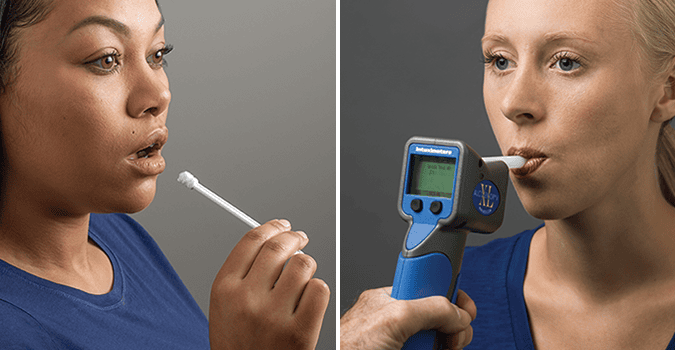
How screening and evidential confirmation serve different purposes
Workplace alcohol programs may use breath testing, saliva alcohol screening, or both. The important distinction is not simply breath versus saliva. It is screening versus confirmation. A screening test identifies whether a confirmatory test is needed. An evidential breath test produces the quantitative result used for confirmation when the device, operator, and procedure meet the applicable requirements.
Both methods have legitimate workplace uses. Breath testing is established for quantitative alcohol measurement and is required for confirmation in U.S. Department of Transportation programs. Saliva alcohol screening offers a portable, minimally equipped way to identify recent alcohol presence. Neither method should be portrayed as inherently unreliable when an approved device is used according to its instructions and the program follows a sound procedure.
The Terms That Matter
Breath alcohol screening
A breath screening test measures alcohol concentration in an exhaled breath sample. Under 49 CFR Part 40, the screening device may be an approved alcohol screening device or an approved evidential breath testing device. A screening result below 0.02 ends the DOT alcohol test. A result of 0.02 or higher requires a separate confirmation test.
Evidential breath testing
An evidential breath testing device, commonly called an EBT, is designed to provide a quantitative breath alcohol result and the safeguards required for evidential use. For DOT confirmation testing, the EBT must be on the approved list and must provide the required printed result, unique test number, air blank, calibration check capability, and other features specified in 49 CFR 40.231. A trained Breath Alcohol Technician conducts the confirmation test.
An EBT can also be used for the initial breath screening step. Its defining value is that an appropriately configured EBT is the only device permitted for a DOT confirmation test. A consumer breathalyzer or an unapproved handheld device is not interchangeable with an approved EBT. Read our article, “Best Practices for Breath Alcohol Testing Procedures” to know fundamental workplace testing steps.
Saliva alcohol screening
A saliva alcohol screening device detects ethanol in oral fluid. It is a screening tool, not an evidential confirmation method under DOT rules. Salivary ethanol generally tracks blood ethanol after the short period immediately following drinking, when alcohol remaining in the mouth can distort the relationship. This is why collection timing and the manufacturer’s instructions matter.
Saliva alcohol screening is intended to identify recent alcohol presence. It does not provide a long lookback period. Detection depends on the amount consumed, elapsed time, the device cutoff, and individual alcohol elimination. Programs should not advertise a universal 12 to 24 hour saliva detection window. Once ethanol has been eliminated from the body below the device cutoff, a direct saliva alcohol screen will not remain positive merely because drinking occurred earlier.
Types of Saliva Alcohol Tests
There are two types of saliva alcohol screening devices, qualitative and quantitative. Qualitative saliva alcohol test devices provide a screening result that indicates whether ethanol is present at or above a specified cutoff, typically through a color change or another threshold indicator. They do not report an exact alcohol concentration.
Quantitative devices, by comparison, produce a numerical measurement of alcohol concentration, allowing the result to be evaluated against a defined policy or regulatory limit. In workplace testing, qualitative saliva devices are generally used for initial screening, while a non-negative result may require confirmation with an approved quantitative method. For DOT-regulated testing, that confirmation must be performed with an approved evidential breath testing device; a saliva screening result cannot serve as the final confirmation result.
A Practical Comparison
| Program question | Breath testing | Saliva alcohol screening |
| Specimen | Exhaled breath | Oral fluid |
| Primary role | Screening or quantitative confirmation, depending on the device and procedure | Initial screening only in a DOT program |
| Result | A numerical breath alcohol concentration from an EBT; some screening devices provide threshold results | Usually a threshold or color based screening result, depending on the approved device |
| DOT screening | Permitted with an approved ASD or EBT | Permitted with an approved saliva ASD |
| DOT confirmation | Required with an approved EBT that meets confirmation specifications | Not permitted |
| Best operational fit | Programs needing quantitative results, confirmation capability, or centralized testing | Programs needing portable screening at field or decentralized locations |
| Main controls | Qualified operator, required waiting period, device calibration and maintenance, and documented procedure | Trained screening test technician, storage limits, expiration date, reading time, oral-fluid collection procedure, and documented follow-up |
How DOT Workplace Alcohol Testing Works
For DOT-regulated testing, the employee first receives a screening test. The test may use breath or saliva, but the device must be authorized for Part 40 use and the person conducting the test must have the required qualification for that device. A Saliva Test Technician may conduct an approved saliva screening test. A Breath Alcohol Technician may conduct breath screening and confirmation testing within the technician’s qualifications.
If the screening result is less than 0.02, no confirmation test is conducted. If it is 0.02 or higher, the program must wait at least 15 minutes and no more than 30 minutes before confirmation. The confirmation must use an approved EBT and must follow the Part 40 sequence, including an air blank and a new breath specimen. The confirmation result, not the screening result, is the final DOT alcohol result.
Part 40 does not authorize blood, urine, EtG, or another specimen or analyte as a substitute for this process. It permits saliva or breath for screening and breath for confirmation. Accordingly, EtG testing should not be included as a workplace alcohol-testing option in an article describing DOT-compliant programs.
Non-Regulated Workplace Testing: What’s Allowed
For non-regulated workplace testing, employers may use breathalyzers, saliva alcohol screening tests, or a combination of both, subject to applicable state and local law and the employer’s written policy. A professional breath alcohol device can provide a quantitative result and may be used for screening or confirmation when the program’s procedures support that use.
Employer’s not regulated by federal regulations are free to establish lower acceptable alcohol concentration thresholds instead of the 0.02 threshold. Additionally, employers are free to define more or fewer reasons for testing as defined in their company policies.
While non-regulated employers have more flexibility in their alcohol testing programs, many employers choose to adopt DOT testing protocols in part or in their entirety.
What the Tests Show
Recent alcohol presence rather than a long history
Breath and direct saliva alcohol tests measure ethanol associated with alcohol currently present in the body. They are useful for determining whether alcohol is present near the time of testing. They are not designed to reconstruct drinking history. A result should be interpreted within the program’s policy, the applicable cutoff, and the time of collection.
A positive alcohol result establishes the measured alcohol concentration or screening threshold at that time. It does not, by itself, describe the amount consumed, the exact time of drinking, or an employee’s behavior. Workplace decisions should use the confirmed result and the employer’s written policy rather than assumptions about consumption.
Mouth alcohol and waiting periods
Recent drinking, mouthwash, breath spray, or another alcohol-containing product can temporarily leave alcohol in the mouth. The controlled waiting period before a confirmation breath test helps prevent residual mouth alcohol from affecting the final result. During the DOT confirmation waiting period, the technician instructs the employee not to eat, drink, place anything in the mouth, or belch.
Saliva screening also requires careful timing. Research has found a strong relationship between salivary and blood ethanol after the immediate post-drinking period, but a specimen collected too soon after drinking can be influenced by alcohol remaining in the mouth. The device’s collection, storage, temperature, and read-time instructions are part of the test procedure and must be followed.
Accuracy Depends on the Whole Testing System
Device category alone does not determine reliability. A defensible result depends on an appropriate device, correct storage and maintenance, a qualified tester, proper timing, an uncontaminated specimen, complete documentation, and confirmation when required. Published performance figures for one device should not be generalized to every breath or saliva product.
For breath testing, employers should verify the device’s approval status and follow its quality assurance plan, calibration checks, inspection schedule, and operating instructions. For saliva screening, employers should verify that the device is approved for the intended program and observe its shelf life, storage temperature, collection procedure, and specified reading time. These controls support both methods rather than favoring one by default.
Choosing a Method for a Workplace Program
Use breath testing when
- the program needs a quantitative breath alcohol result
- DOT confirmation capability is required
- the employer has access to a qualified BAT and an approved, properly maintained device
- the procedure calls for an evidential result rather than a preliminary screen
Use saliva alcohol screening when
- the program needs a portable initial screen for recent alcohol presence
- testing occurs at remote or decentralized locations
- a single use device simplifies logistics and avoids instrument calibration
- the program already provides a compliant path to breath confirmation when required
Use both when
A combined program can use saliva or breath for screening and reserve an approved EBT for confirmation. This is not a judgment that saliva is inferior. The two tools perform different roles. The program should define those roles in writing before testing begins.
Program Controls for Employers
- Identify whether each test is DOT regulated or non-DOT before collection and use the correct form and procedure.
- Check current state and local requirements for non-DOT testing
- State the purpose of testing, the cutoff or threshold, the confirmation process, and the consequences in the written policy.
- Use only devices appropriate for the applicable program and verify current approval status before purchase and use.
- Train and qualify testing personnel for the method they administer.
- Follow the manufacturer’s instructions for storage, expiration, calibration, quality control, specimen collection, and result interpretation.
- Base action on the confirmation result when confirmation is required, not on a preliminary screening result.
- Protect confidentiality and maintain records according to the applicable program rules.
The Right Distinction
The most useful workplace comparison is between a screening tool and an evidential confirmation process. Approved breath devices can serve the screening role, and qualifying EBTs can also serve the confirmation role. Approved saliva devices offer practical, reliable screening for recent alcohol presence but do not replace evidential breath confirmation in a DOT program.
Employers do not need to dismiss either method. They need to select the correct device for the test’s purpose, follow the required procedure, and confirm a non-negative screen before relying on it when the governing rules or workplace policy require confirmation.
Frequently Asked Questions
What is the difference between an alcohol screening test and a confirmation test?
A screening test determines whether alcohol is present at or above a specified threshold and whether further testing is required. A confirmation test provides the final quantitative result used for regulatory or workplace-policy decisions. Under DOT rules, breath or saliva may be used for screening, but confirmation must be conducted with an approved evidential breath testing device.
Are saliva alcohol tests qualitative or quantitative?
Most workplace saliva alcohol devices are qualitative screening tests. They indicate whether ethanol is present at or above a specified cutoff, often through a color change, but do not report an exact alcohol concentration. Quantitative devices provide a numerical result. A non-negative qualitative saliva screen may therefore require confirmation with an approved quantitative method.
How long can alcohol be detected in saliva?
Direct saliva alcohol tests detect ethanol associated with alcohol recently consumed and still present in the body. They do not provide a long lookback period. The detection period varies with the amount consumed, elapsed time, individual alcohol elimination, and the device’s cutoff. Employers should not describe saliva alcohol testing as having a universal 12- or 24-hour detection window.
Can non-regulated employers use breathalyzers and saliva alcohol tests?
Non-regulated employers may use breathalyzers, saliva screening tests, or both, subject to applicable state and local law, employment agreements, and the employer’s written policy. Breath devices may be used when a numerical result is needed, while saliva devices can provide convenient screening at remote or decentralized locations. The policy should identify the test’s purpose, applicable cutoff, confirmation procedure, and consequences before testing begins.
Is EtG testing permitted in workplace alcohol-testing programs?
EtG is not an authorized testing method under the DOT workplace alcohol-testing framework. DOT regulations permit approved breath or saliva devices for screening and an approved evidential breath testing device for confirmation. Requirements outside DOT-regulated programs can vary, but EtG detects prior alcohol exposure rather than current alcohol concentration and should not be presented as equivalent to breath or direct saliva alcohol testing.
Sources
Electronic Code of Federal Regulations, 49 CFR Part 40, Subpart K, sections 40.229 through 40.235, and Subpart L, sections 40.241 through 40.255. https://www.ecfr.gov/current/title-49/subtitle-A/part-40
U.S. Department of Transportation, Approved Screening Devices to Measure Alcohol in Bodily Fluids. https://www.transportation.gov/odapc/Approved-Screening-Devices-to-Measure-Alcohol
U.S. Department of Transportation, section 40.277, alcohol tests permitted under Part 40. https://www.transportation.gov/odapc/part40/40-277
National Highway Traffic Safety Administration, Alcohol Measurement Devices and Conforming Products Lists. https://www.nhtsa.gov/drunk-driving/alcohol-measurement-devices
McColl K E, Whiting B, Moore M R, and Goldberg A. Correlation of ethanol concentrations in blood and saliva. Clinical Science. 1979;56(3):283-286. https://pubmed.ncbi.nlm.nih.gov/477212/