
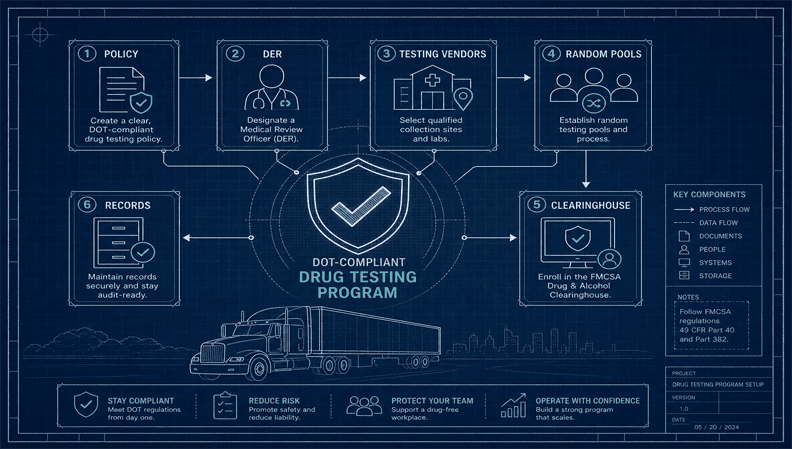
How do I set up a DOT-compliant drug and alcohol testing program? It’s a question every DOT-regulated employer has to answer correctly, because getting it wrong is expensive. Fines, out-of-service orders, and legal liability are the real consequences of a program that looks compliant on the surface but falls apart under audit. The regulation is specific, the sequence matters, and there’s no room to wing it.
The federal rule governing how DOT drug and alcohol testing must be conducted is 49 CFR Part 40. It applies across all transportation modes and covers everything from how specimens are collected to how results are reported. Every DOT-regulated employer operates under Part 40, no exceptions.
This guide walks through every required component in order. If you’re building a program from scratch, or fixing one that has gaps, this is your roadmap. AlcoPro has supported DOT-regulated employers through this process for decades, from compliant testing products to certified training. This article is intended to provide a foundation and resources to help get you started.
Understand what 49 CFR Part 40 requires from employers
Before you set anything up, you need to know which DOT agency governs your operation. Part 40 regulations is the procedural backbone for all DOT drug and alcohol testing, but the specific rules that apply to your employees come from your modal agency. FMCSA governs trucking and commercial motor vehicle operators. FAA covers aviation. FTA covers transit. FRA covers rail. PHMSA covers pipeline workers in oil, gas, and hazardous materials industries. Each agency has its own regulations, and they all run on top of Part 40.
Your modal agency determines which employees are covered by DOT testing. DOT testing applies only to employees in safety-sensitive functions, not your entire workforce. Under FMCSA, that means CDL drivers operating commercial motor vehicles on public roads. Other agencies define safety-sensitive roles differently. Getting this wrong in either direction is a compliance problem: under-testing is a violation, and over-testing creates unnecessary cost and legal exposure.
Agency-specific regulations also define testing timelines for post-accident situations and the events that constitute the need for post-accident testing.
The starting point for any drug and alcohol testing program is to know 49 CFR Part 40 and the DOT agency regulations that govern your company, keeping in mind that your industry, may have safety-sensitive employees governed under more than one agency.
How to set up a DOT-compliant drug testing program: policy and DER first
Two things must exist before a single test is conducted: a written company substance abuse policy and a Designated Employer Representative. Per 49 CFR Part 40 Subpart B and your modal agency’s employer requirements, the policy must identify covered employees, describe prohibited conduct, explain the testing reasons and procedures under Part 40, name a contact person, and spell out the consequences of violations. Every covered employee must receive the policy and sign a certificate of receipt. A verbal acknowledgment doesn’t satisfy the requirement.
Avoid generic drug-free workplace templates. Your policy needs to be mode-specific and current with applicable Part 40 rules. A policy written for a trucking company doesn’t work for a transit agency. A policy that hasn’t been updated in five years may not reflect current regulations. Consider working with a consultant familiar with the industry or TPA with legal resources to structure your policy so that it’s legally sound.
The Designated Employer Representative (DER) is the person inside your organization who manages the company’s testing program. The DER receives verified results from the MRO, removes employees who test positive from safety functions, directly communicates with program vendors, and ensures that compliance actions are taken. The DER must be a company employee, not a service agent or TPA. Define the DER’s authority in writing before a positive result comes in. That is not the moment you want ambiguity about who does what. View the article, “Comprehensive Guide to DER Authority Limits”.

Choose your vendors before you test anyone
A DOT drug testing program requires specific service providers, and using the wrong ones, or skipping a required one, puts the entire program out of compliance. Under 49 CFR Part 40 Subpart F and the HHS Mandatory Guidelines, all urine specimens must go to a lab on the current SAMHSA/HHS-certified laboratory list. Using an uncertified lab voids the test entirely.
Your Medical Review Officer (MRO) must be a licensed physician (M.D. or D.O.) who has completed DOT qualification training, passed a board-certified examination, and completed requalification every five years, as specified in 49 CFR Part 40 Subpart G (§§ 40.121, 40.167). The MRO independently reviews lab results, contacts employees with non-negative results, and reports verified outcomes to your DER. This role is not administrative, it’s a clinical safeguard built into the regulation.
A Substance Abuse Professional (SAP) enters the picture only after a violation. The SAP conducts a face-to-face clinical evaluation, recommends education or treatment, and authorizes the employee for return-to-duty testing once compliance is confirmed. A Third-Party Administrator (TPA) can handle a large share of your program’s administrative work, random testing pool management, test scheduling, and Clearinghouse reporting, but the employer remains legally responsible for compliance regardless of what the TPA handles. Under Part 40 Subpart B and FMCSA Clearinghouse guidance, FMCSA-regulated employers must also designate the TPA in the Clearinghouse before the TPA can act on their behalf.
Specimen Collectors, Breath Alcohol Technicians, and Screening Test Technicians are service agents trained to perform DOT drug and alcohol testing. A company outsourcing drug and alcohol testing to one or more of these service agents, must have proof they have received the required training. It is important to request copies of training certificates or documentation from each of these service agents in the event of a DOT audit.
Setting up your testing events and random pool for a DOT-compliant testing program
DOT rules require six specific testing events, or reasons for testing, and none are optional:
- Pre-employment: A negative drug test result is required before a safety-sensitive employee performs safety functions for the first time. Pre-employment alcohol testing is optional.
- Random: Conducted on an unannounced, ongoing basis throughout the year using a scientifically valid selection method that gives every covered employee an equal chance of selection (per Part 40 random selection requirements).
- Post-accident: Required after qualifying incidents or events outlined in your modal regulations. For example, under FMCSA, certain crash thresholds trigger mandatory post-accident testing.
- Reasonable suspicion: Initiated by a trained supervisor based on direct observation of specific, articulable signs of drug use or alcohol misuse.
- Return-to-duty: Required before an employee who committed a violation returns to safety-sensitive functions.
- Follow-up: Conducted according to the SAP’s follow-up testing plan following return-to-duty.
Random testing rates are set annually and represent the minimum percentage of your covered employee pool that must be tested each calendar year. For 2026, the rates published by ODAPC are:
- FMCSA: 50% for drugs, 10% for alcohol
- FAA: 25% for drugs, 10% for alcohol
- FTA: 50% for drugs, 10% for alcohol
- FRA: 25% for drugs (maintenance-of-way employees) / 50% for drugs (mechanical employees); alcohol rates vary by employee category, verify current FRA rates at ODAPC before finalizing your program
- PHMSA: 50% for drugs; alcohol random testing not applicable
Random selection must use a scientifically valid method. Pulling names from a hat does not qualify. For smaller employers especially, joining a consortium or using a TPA to manage the random pool is the most reliable way to meet this requirement. The selection process must be documented and records retained.
Train supervisors and ensure collectors and BATs are certified
Every supervisor who oversees safety-sensitive employees must complete DOT-required reasonable suspicion training: at least 60 minutes on the signs and symptoms of drug use, and at least 60 minutes on alcohol misuse, as required under the applicable modal regulations. Without this training, a supervisor cannot legally initiate a reasonable suspicion drug or alcohol test. A missed test when one was warranted is a program failure, and it exposes your organization to liability that compliance is designed to prevent. Reasonable suspicion for supervisors training must be documented and records retained. View the article, “Guide to Reasonable Suspicion Training for DOT Supervisors” to know the specific training requirements and common errors.
Specimen Collectors must complete DOT specimen collector training and demonstrate proficiency through five consecutive error-free mock collections before independently collecting DOT specimens. Training consists of procedural training in the federal regulations and proficiency training consisting of five mock collections. These mock collections consist of two uneventful scenarios, one insufficient quantity scenario, one temperature out-of-range scenario, and one scenario where the employee refuses to sign the CCF. A qualified monitor must evaluate the performance in person or in real time and attest in writing that the collections were error-free. Refresher training is required every five years.
Breath Alcohol Technicians (BATs) must complete procedural training in the regulations for alcohol testing and proficiency training on an evidential breath alcohol testing device before conducting breath alcohol tests. As a part of their training, BATs must also conduct seven error-free mock alcohol testing with a qualified instructor. That certification requirement is non-negotiable, and finding a qualified training provider matters.
AlcoPro offers DOT-certified BAT and specimen collector training backed by a Training Success Guarantee. We also offer compliant testing supplies, approved breathalyzers, and anti-tampering tools so your program is fully equipped when training is complete. View the “DOT Drug and Alcohol Training Requirements” article for specific training guidance.
Register for the Clearinghouse and lock in your records
For FMCSA-regulated employers, the Drug and Alcohol Clearinghouse is a federal requirement, not an optional resource. It’s the database that tracks CDL driver violations, and employers are legally required to query it before a driver performs safety-sensitive functions and at least once every 12 months for all currently employed covered drivers.
To register, go to the Clearinghouse site, sign in with a Login.gov account, select the Employer role, and complete company verification. If you’re using a TPA, designate them in the system before they can query or report on your behalf. All queries require driver consent. Violation records are stored for five years, or until the driver completes the return-to-duty process, whichever is longer. Reporting obligations include alcohol test results at or above 0.04, refusals to test, actual knowledge violations, negative return-to-duty results, and successful completion of a follow-up testing plan.
Recordkeeping is where many programs have gaps at audit time. Under 49 CFR § 40.333, the retention periods by record type are:
- 5 years: positive results, refusals, substituted/adulterated results, SAP reports, follow-up results and schedules, and alcohol test results at or above 0.02
- 3 years: records received from previous employers about drug and alcohol history
- 2 years: inspection, maintenance, and calibration records for EBTs
- 1 year: negative and cancelled results, alcohol test results below 0.02
Build a secure, organized recordkeeping system before the first test is collected. Recordkeeping failures are among the most common compliance citations, and they’re entirely avoidable.
This program requires ongoing attention, not a one-time setup
Setting up a DOT-compliant drug testing program is not a one-time task. The regulatory requirements are ongoing. Random rates change. Part 40 gets updated. The Clearinghouse adds requirements. Your covered employee population shifts. Programs that were fully compliant at launch can drift out of compliance if no one is watching, which is why these steps are crucial:
- Appoint a skilled DER
- Structure a company substance abuse policy
- Audit your program regularly
- Seek compliance consulting and TPA support when needed
- Update your policy when regulations change
- Verify that your vendors remain qualified
If you’re asking how do I set up a DOT-compliant drug testing program and where to start, the sequence is clear: policy and DER first, then vendors, then random pool, then supervisor training and personnel certification, then Clearinghouse registration, then records. Each step has to be done correctly before the next one means anything.
AlcoPro is a trusted resource for DOT-regulated employers building and maintaining compliant programs. From breath alcohol testing devices and supplies to supervisor training to DOT-certified BAT and specimen collector training, plus same-day shipping when you need product fast, AlcoPro has what you need to get it right. Start at AlcoPro.com and build your program on solid ground from day one.